 |
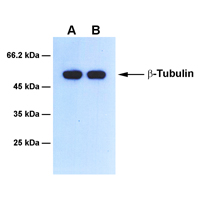
Western blotting (WB): HT-1080 (A) and NIH/3T3 (B) cell extracts prepared in 1% Triton-X lysis buffer. |
Product Information
|
Gene Symbol:
|
TUBB (Human)
|
|
Molecular Weight:
|
50 kDa (β-tubulin), but it appears as ~55 kDa in SDS-PAGE.
|
|
Source:
|
This is a mouse monoclonal antibody raised against the full-length β-tubulin of human origin.
|
|
Clone #:
|
2F4
|
|
Isotype:
|
IgG1
|
|
Specificity:
|
This antibody detects β-tubulin of human & mouse origins. Other species have not been tested.
|
|
Physical Form:
|
Freeze-dried powder from 1 × PBS solution, or cell culture media with 0.02% NaN3
|
|
Application:
|
• Western blotting (WB, dilution range: 1:1,000 - 10,000).
• Other applications have not been tested in house.
|
|
Storage:
|
Store freeze-dried powder at 4°C upon arrival. When ready to use, rehydrate with 0.1 ml or desired volume of distilled H2O and centrifuge if not clear. For long-term storage, make aliquots and keep them at -20°C or below. Avoid repeated freezing and thawing cycles.
|
Background
Tubulin is a small family of globular proteins in nearly all eukaryotic cells. The most common members of this family are α-tubulin and β-tubulin, the proteins that make up microtubules. To form microtubules, the dimers of α- and β-tubulin bind to GTP and assemble onto the (+) ends of microtubules while in the GTP-bound state. After a dimer is incorporated into microtubule, the molecule of GTP bound to the β-tubulin subunit eventually hydrolyzes into GDP through inter-dimer contacts along the microtubule filament. Thus, the binding of β-tubulin to GTP/GDP influences the formation of microtubules, and GTP hydrolysis is essential for the growth of microtubules via dynamic instability in cells.
Important Note
This product is intended for research use only, not for use in human therapeutic or diagnostic procedures.
|