 |
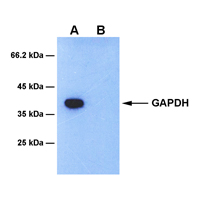
Western blotting (WB): HT-1080 (A) and NIH/3T3 (B) cell extracts prepared in 1% Triton-X lysis buffer. |
Product Information
|
Gene Symbol:
|
GAPDH (Human)
|
|
Molecular Weight:
|
37 kDa (GAPDH)
|
|
Source:
|
This is a mouse monoclonal antibody raised against the full-length GAPDH of human origin.
|
|
Clone #:
|
4B6
|
|
Isotype:
|
IgG1
|
|
Specificity:
|
This antibody detects human but not mouse GAPDHs. Other species have not been tested yet.
|
|
Physical Form:
|
Freeze-dried powder from 1 × PBS solution, or cell culture media with 0.02% NaN3
|
|
Application:
|
• Western blotting (WB, dilution range: 1:1,000 - 10,000).
• Other applications have not been tested in house.
|
|
Storage:
|
Store freeze-dried powder at 4°C upon arrival. When ready to use, rehydrate with 0.1 ml or desired volume of distilled H2O and centrifuge if not clear. For long-term storage, make aliquots and keep them at -20°C or below. Avoid repeated freezing and thawing cycles.
|
Background
Glyceraldehyde 3-phosphate dehydrogenase (GAPDH or less commonly known as G3PDH) (EC 1.2.1.12) is an enzyme that catalyses the conversion of glyceraldehyde 3-phosphate to D-glycerate 1,3-bisphosphate in the cytosol of eukaryotic cells. This is the sixth step of glycolysis, an important pathway to supply energy and carbon molecules for the needs of cellular activities. When cells are under oxidative stress, GAPDH is inactivated to allow cells to produce antioxidant cofactor NADPH from NADP+. In addition to this long established metabolic function, GAPDH has recently been implicated in several non-metabolic processes, including transcription activation, initiation of apoptosis, and ER to Golgi vesicle shuttling.
Important Note
This product is intended for research use only, not for use in human therapeutic or diagnostic procedures.
|